
UK politics! Where do you Start?
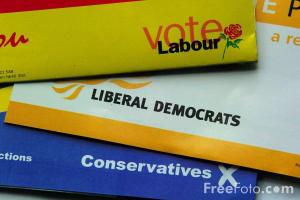 UK politics is made up of 3 main political parties: Conservative, Labour and Liberal Democrats. Unlike US politics where one votes for a specific leader – The president, in the UK you vote for the party to govern.
Whatever Party gains the majority of seats in the House of Commons (one of two chambers in the Houses of Parliament, Westminster, London) forms the duly elected government. Whoever happens to be that majority Party’s Leader, will then become the Prime Minister (PM) of the UK. If there is ever a challenge within the governing party for the Party Leader position and the existing leader is replaced for a new leader, that new leader would then become PM by default of their Party Leader status – Clear? Good!
Usually the UK Government alternates between Labour and Conservative (or ‘Tory’ as they are also known) Parties. Liberal ‘Dems’ have not been a governing party for many a year… until recently!
So, after years of Labour in power with Tony Blair, then Gordon Brown, the UK public became totally pissed off with the boys in red and kicked them in the balls during a General Election. However, the electorate was pretty clear it did not want the Tories in sole power either. None of the 2 big parties managed to gain the majority of seats it needed to form a government. All of this suddenly made the Liberal ‘Dems’ a big player in UK politics. Liberal ‘Dems’ had to then decide which of the 2 bigger parties they may like to partner with to form a coalition government? Labour was thought to be the Lib Dems natural political ally, but in a shocking turn of events they decide to partner with the Tories and by combining their elected seats, they were able to take the majority of seats in the Houses of Commons needed to able to form a coalition government, something not seen since WW2 and Churchill. Labour was effectively cast into the abyss and a new Conservative/Lib Dem Government governs the UK today.
But for how long can this coalition continue? With David Cameron(Tory) as PM and Nick Clegg (Lib Dem) as Deputy PM, the relationship is fragile, but seems to be holding for now. It has brought the UK through some tough economic times and given a certain amount of stability to the Union, but for how long? Folks are starting to twitch at this arrangement and there may well be another General Election soon to try to vote in a single majority (1 Party) government instead of continuing with a fragile coalition government. Certainly the Tories would love to govern on their own without obstruction and interference from the Lib Dems, but if they do call a General Election sooner rather than later in an attempt to reach that goal, they would be gambling that the UK electorate will not instead revert back to supporting Labour and vote them back into power. (Lib Dems by the way, do not have the voting base to form a majority party and govern on their own and is not likely to any time soon.) David Cameron has to be careful on this and judge when the climate is right to call that General Election or he will find himself with a one way ticket to political obscurity. He is as about as popular as a dose of trots currently, so he needs to be careful!
Independence for Scotland
On September 18th 2014, Scotland held a referendum on whether they wanted to leave the Union of the UK and form their own nation country. 55% of Scots decided that they did indeed want to remain in the Union and stay a part of the United Kingdom of Great Britain and Northern Ireland.
Hoorah! I am glad they will remain with us. Our Union is much stronger together than separate and Scotland, along with Wales and Northern Ireland bring great cultural diversity to the Union. If Scotland would have voted the other way, I fear they would have struggled big time to run an effective country. Their Economy, Currency, Industry, Health System and Defence Forces would have been challenged to put it mildly. With the North Sea Oil supplies virtually gone, I don’t think their whisky sales would have covered the shortfall.
I regard myself as British first, then English (except when it comes to Rugby – England to the grave). I would encourage all to think the same; we can still retain our separate nation identities, cultures and traditions and be as one British Union. I admire the Scots, Welsh and Irish (North & indeed South) and think we make a cracking partnership of home nations. Long live the Union.
 An Englishman in New Jersey